
Repair
- Suits isolated leaks, a cracked section or a loose bracket
- Keeps sound sections and brackets in place
- Often completed with minimal disruption
- Does not correct a system that is undersized or poorly fallen
Roofing
Gutters carry rainwater from the roof to the drain, and when they fail, water tends to run down walls, rot fascias and soak the ground near foundations. Many gutter problems are simple to put right. Here is how we check, clear, repair and replace guttering.
Gutters explained
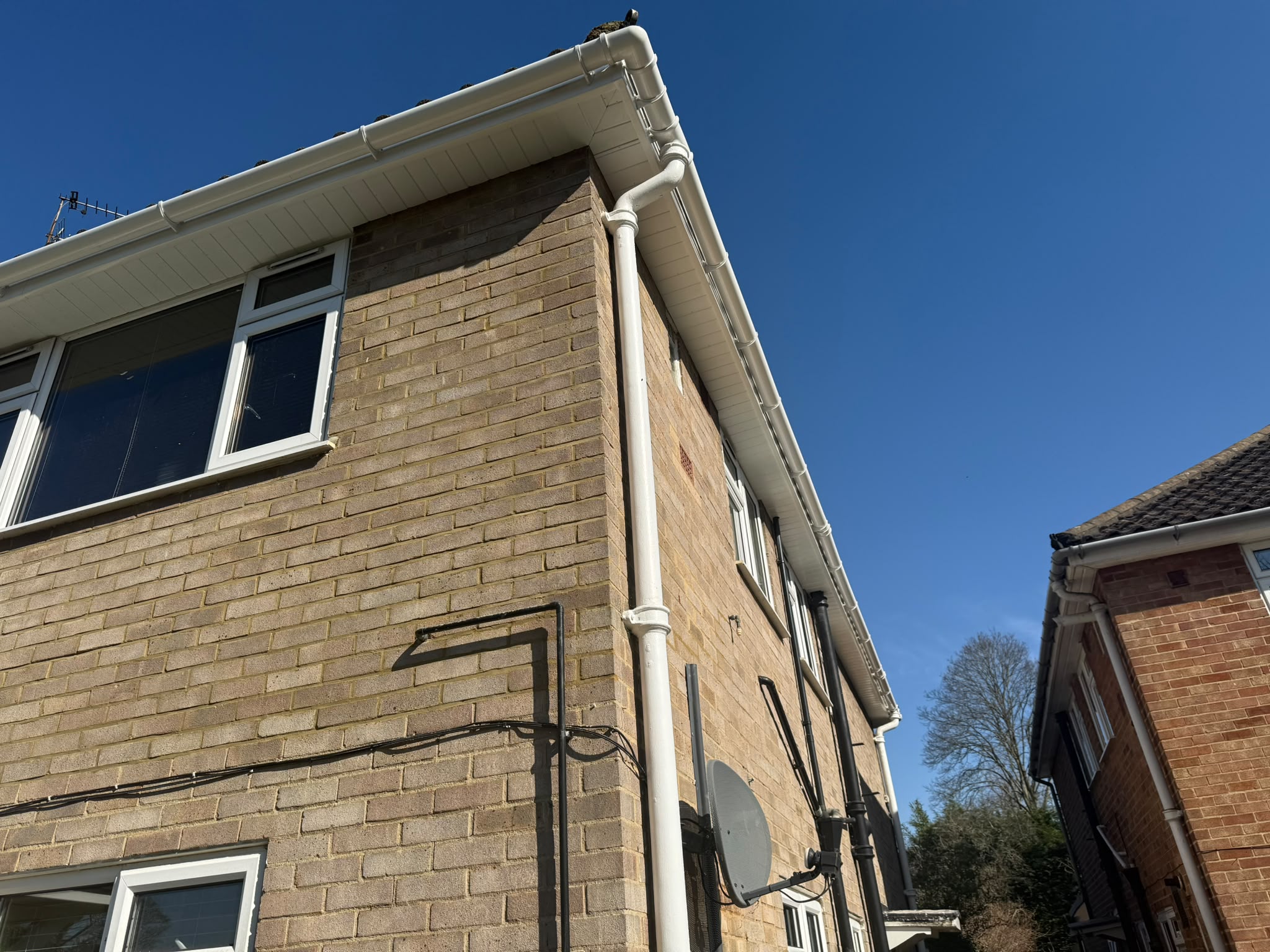
A gutter system is made up of the gutters themselves, which collect water along the roof edge, the downpipes that carry it down the building, and outlets at ground level. Brackets or fixings hold the gutters to the fascia. Each part needs a gentle fall towards the outlet, so that water moves along instead of sitting.
A healthy system keeps water well away from walls and foundations. When one part fails, such as a joint or a bracket, the whole run can be affected. We look at the system as a whole rather than only the section that prompted the call.
Early warnings
Gutter faults are often visible from the ground. These are the signs we see most often.
Gutters that dip between brackets, or pull away from the fascia, can hold water and may come down in strong wind.
Water spilling over the front of the gutter usually points to a blockage, a lost fall or an outlet that is too small.
Dark streaks, green growth or damp on the wall beneath a gutter can show that water is escaping at a joint or outlet.
Cracks in downpipes, or joints that have separated, let water spill onto walls and the ground close to the building.
Blocked gutters are one of the most common causes of water damage around a roof. Leaves, moss, grit and nesting material build up in bends and outlets, and water then backs up behind them. Clearing is often the first step, and it should be done from a stable position. Please do not lean out from a ladder or climb onto a roof to do it.
Clearing does not always solve the problem. If gutters block repeatedly, the fall may be wrong, the outlet may be too small, or a bend may be poorly placed. We look for these faults during the survey so that the solution addresses the cause rather than the symptom.
The process
Many repairs are quick, but a poor fall or a rotten fascia needs more work before the gutter is refitted.
We check the gutters, brackets, joints, outlets and downpipes, and look at the fascia behind them. Any loose or rotten timber is noted.
Debris is removed and the system is flushed through to check that water flows freely to the outlet.
Cracked or split sections are replaced, and joints are resealed or remade. Damaged brackets are upgraded where the fixing point is sound.
Gutters are refixed to a consistent fall so that water runs towards the outlet. This stage largely determines whether the system works in heavy rain.
We run water through the system to check the joints and outlets, tidy the area, and explain what was done.
Survey
Tell us where the water is going and we arrange an inspection. We explain the cause, the repair options, and whether the fascia or the outlets need attention too.
Replacement
A replacement system should suit the size of the roof and the amount of water it sheds. Discuss these points before you decide.
Options
A repair can be the right answer for a single leaking joint, but a run with many faults may be better renewed.
Gutters work together with the roof covering, the fascia and the walls. A slipped tile that spills water onto the gutter, a verge that lets rain run down the wall, or a valley that discharges onto a gutter can all overload a section never intended to take that load. When we check gutters, we also trace where the water is coming from, so that the gutter is not blamed for a fault elsewhere.
Downpipes are part of the same picture. A downpipe that is cracked, loose at its bracket or blocked at the bottom will hold water in the system and spill it at the joints. We check that each pipe discharges clear of paths and walls, and we report any water that pools at the base of the building.
Related
Questions
Common questions about clearing, repairing and replacing gutters.
It depends on nearby trees, the roof shape and the amount of debris. Gutters under trees usually need more attention than those in open areas. Check them after autumn and after storms, and clear them whenever debris is building up.
Often yes. Many joints can be resealed or remade, provided the gutter itself is sound. If the joint is failing because the gutter has moved or the fixing has failed, we explain the underlying cause.
The gutter may be overflowing because it is blocked, the fall is wrong, or the outlet is too small for the roof. A leaking joint or a damaged downpipe can have the same effect. The survey shows which applies.
Not always. Age alone is not the deciding factor. The condition of the fixings, the joints and the fascia matters more. We tell you whether a repair or a replacement is likely to give the more dependable result.
uPVC gutters are widely used and can perform well when correctly sized, fixed and supported. Their strength depends on bracket spacing and fall, and we discuss the material with you during the survey.
Where we work
We work across five regional areas: North London, North West London, West London, Hertfordshire, Buckinghamshire. Not sure if we cover your street? Call us on 01632 960123, or see all areas we cover.
Next step
If your gutters are overflowing or leaking, arrange an inspection before damp spreads. Use the contact page to get in touch.